
Overview
In East London's Tower Hamlets, Hackney, and Newham, overactive bladder affects a substantial proportion of adults over 50.Read moreShow less
But NHS OAB management in this area is limited to GP-prescribed antimuscarinics without specialist assessment, structured bladder training, or access to Botox injection for those who do not respond to medication. Private specialist OAB care has simply not been available in East London's postcodes. London Independent Hospital at Beaumont Square, Stepney E1 changes this: Dr. Harshawardhan Godbole FRCS provides private OAB assessment — bladder diary review, exclusion of underlying causes, structured treatment pathway — at this East London location, accessible from Stepney Green or Whitechapel Underground in 10–15 minutes, at a £300 consultation fee that reflects the economic diversity of this community.
What to know
Private Overactive Bladder Treatment at London Independent Hospital, Stepney
Overactive bladder (OAB) is characterised by urinary urgency.Read moreShow less
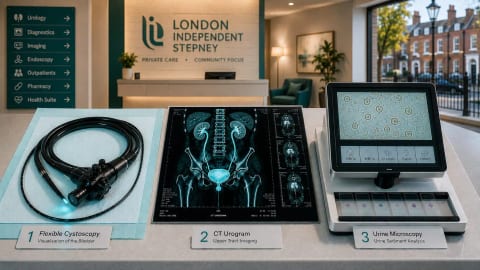
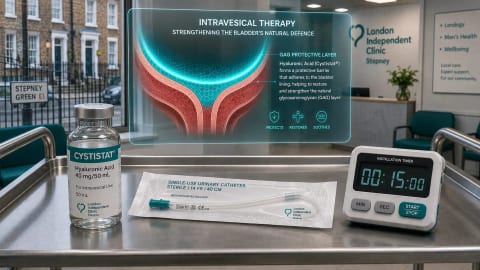
A sudden, compelling need to urinate that is difficult to defer — with or without urgency urinary incontinence, frequency (eight or more voids per day), and nocturia. The detrusor muscle contracts involuntarily. Bladder diary and urodynamics guide diagnosis. Treatment ladder: bladder training and pelvic floor exercises; antimuscarinics (oxybutynin, solifenacin, tolterodine) or beta-3 agonists (mirabegron); for refractory cases — intravesical botulinum toxin injection or tibial nerve stimulation. Underlying causes (UTI, bladder cancer, BPH) must be excluded before OAB treatment begins.
OAB in East London's South Asian Communities — Diabetes and Bladder Function
Type 2 diabetes — prevalent in Tower Hamlets' Bangladeshi community and Newham's South Asian communities — causes diabetic cystopathy, which can produce OAB-like symptoms through detrusor hyperreflexia or, conversely, an underactive bladder from neuropathy.Read moreShow less
The distinction between diabetic OAB and diabetic underactive bladder is clinically important: antimuscarinics worsen urinary retention in an underactive bladder. At London Independent Hospital, OAB assessment in diabetic patients includes post-void residual measurement and urodynamics where indicated to confirm the detrusor status before prescribing antimuscarinics.
Cultural Barriers to OAB Presentation in East London
Urgency incontinence — leakage of urine — is one of the most embarrassing symptoms for patients from South Asian and African communities where bodily functions are rarely discussed publicly.Read moreShow less
Many East London women with urgency incontinence manage with pads silently for years without seeking specialist help. At London Independent Hospital, Dr. Godbole's team approaches OAB consultations with specific cultural sensitivity — creating an environment where urinary symptoms can be discussed openly, and where the clinical assessment is conducted with appropriate privacy and dignity.
Travel and Parking Guide – London Independent Hospital, Stepney
1 Beaumont Square, Stepney E1 4NL.Read moreShow less
Underground: Stepney Green (District/H&C), 10 minutes walk. Whitechapel (Elizabeth line + District/H&C), 15 minutes walk. Bus routes 25, 205. By road from Canary Wharf: 10 minutes. Street parking around Beaumont Square.
Why London Independent
Diabetic OAB assessment at London Independent Hospital specifically differentiates detrusor overactivity from diabetic underactive bladder.Read moreShow less
Preventing the clinical error of prescribing antimuscarinics in an underactive bladder.
Nearby areas
StepneyMile EndWhitechapelBethnal GreenBowCanary Wharf
London Independent Hospital serves OAB patients from Stepney, Mile End, Whitechapel, Bethnal Green, Bow, Canary Wharf, Poplar, Tower Hamlets, Hackney, and Newham.Read moreShow less
The Elizabeth line at Whitechapel extends access to Stratford.
Patient reviews
Placeholder reviews. Replace with verified Doctify or Google reviews (data/reviews-london.json) before launch.
★★★★★
Lorem ipsum dolor sit amet, consectetur adipiscing elit. Integer posuere erat a ante venenatis dapibus posuere velit aliquet.
★★★★★
Sed posuere consectetur est at lobortis. Cras mattis consectetur purus sit amet fermentum. Donec ullamcorper nulla non metus auctor fringilla.
★★★★★
Maecenas faucibus mollis interdum. Vestibulum id ligula porta felis euismod semper. Nulla vitae elit libero, a pharetra augue.
Questions
Is there a private OAB specialist accessible from Whitechapel and Tower Hamlets in East London?
Yes. HRG Urology at London Independent Hospital, Beaumont Square, Stepney E1 provides private OAB assessment — bladder diary review, structured treatment pathway, and Botox injection for refractory cases — accessible from Stepney Green Underground (10 minutes walk) and Whitechapel (15 minutes walk). Call +44 (0)7884 183968 to book.
I have type 2 diabetes and urgency symptoms — how is this assessed differently at London Independent Hospital?
Diabetic patients with urgency require post-void residual measurement before any anticholinergic is prescribed — to confirm the bladder is emptying adequately rather than retaining urine from diabetic detrusor underactivity. Elevated post-void residual in a diabetic patient with urgency suggests underactive bladder mimicking OAB rather than true detrusor overactivity. Antimuscarinics worsen retention in underactive bladder and should be avoided in this scenario. Dr. Godbole's assessment at London Independent Hospital performs this critical distinction routinely in diabetic patients.
I am a Bangladeshi woman with urgency leakage — is the consultation at London Independent Hospital private?
Completely. All OAB consultations at London Independent Hospital are conducted in private consultation rooms with strict patient confidentiality. Family members are welcome to attend if the patient prefers. The team approaches consultations with sensitivity to cultural preferences around discussing bodily functions — there is no expectation of discussing urgency or leakage in front of others without your explicit choice to involve them.
How many sessions of bladder training are typically needed before medication is added?
Bladder training is usually maintained for 6–8 weeks before medication is added — this is sufficient time to assess whether structured voiding schedule progression can achieve adequate urgency control independently. Many patients achieve clinically meaningful improvement from bladder training alone within this period. If bladder training produces insufficient improvement at 6 weeks, medication is added rather than waiting longer. At London Independent Hospital, the 6-week bladder training review is a structured appointment that assesses progress and determines the next step.
What is the waiting time for Botox bladder injection at London Independent Hospital?
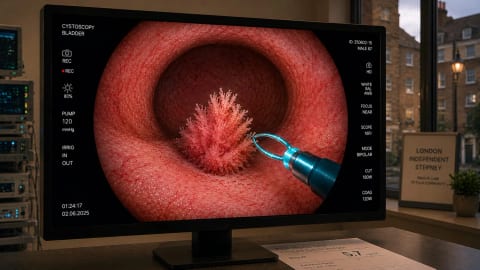
Most patients who have been assessed and found eligible for Botox injection at London Independent Hospital have the procedure arranged within 2–4 weeks of the decision to proceed. The procedure takes 20 minutes under flexible cystoscopy without general anaesthesia in most patients. Patients are taught clean intermittent self-catheterisation before the procedure in case of temporary urinary retention. Call +44 (0)7884 183968 to discuss the Botox injection pathway.