Overview
A kidney cancer diagnosis is among the most anxiety-provoking clinical findings a patient from Naupada, Vartak Nagar, or Wagle Estate can receive.Read moreShow less
Many kidney tumours are discovered incidentally — on an ultrasound or CT scan performed for another purpose — before any symptoms develop, which is actually the optimal scenario for treatment. Whether discovered incidentally or through symptoms, what patients from Thane West need immediately after a kidney cancer diagnosis is access to a specialist who can interpret the imaging accurately, explain the treatment options clearly, and — where surgery is indicated — perform it using minimally invasive laparoscopic techniques. At Nest Hospital in Naupada, HRG Urology provides exactly that through Dr. Harshawardhan Godbole FRCS — Cancer Lead and MDT Lead at North Middlesex University Hospital NHS Trust.
What to know
Kidney Cancer Treatment at Nest Hospital, Naupada
Kidney cancer — most commonly renal cell carcinoma (RCC) — arises from kidney tubule lining cells.Read moreShow less
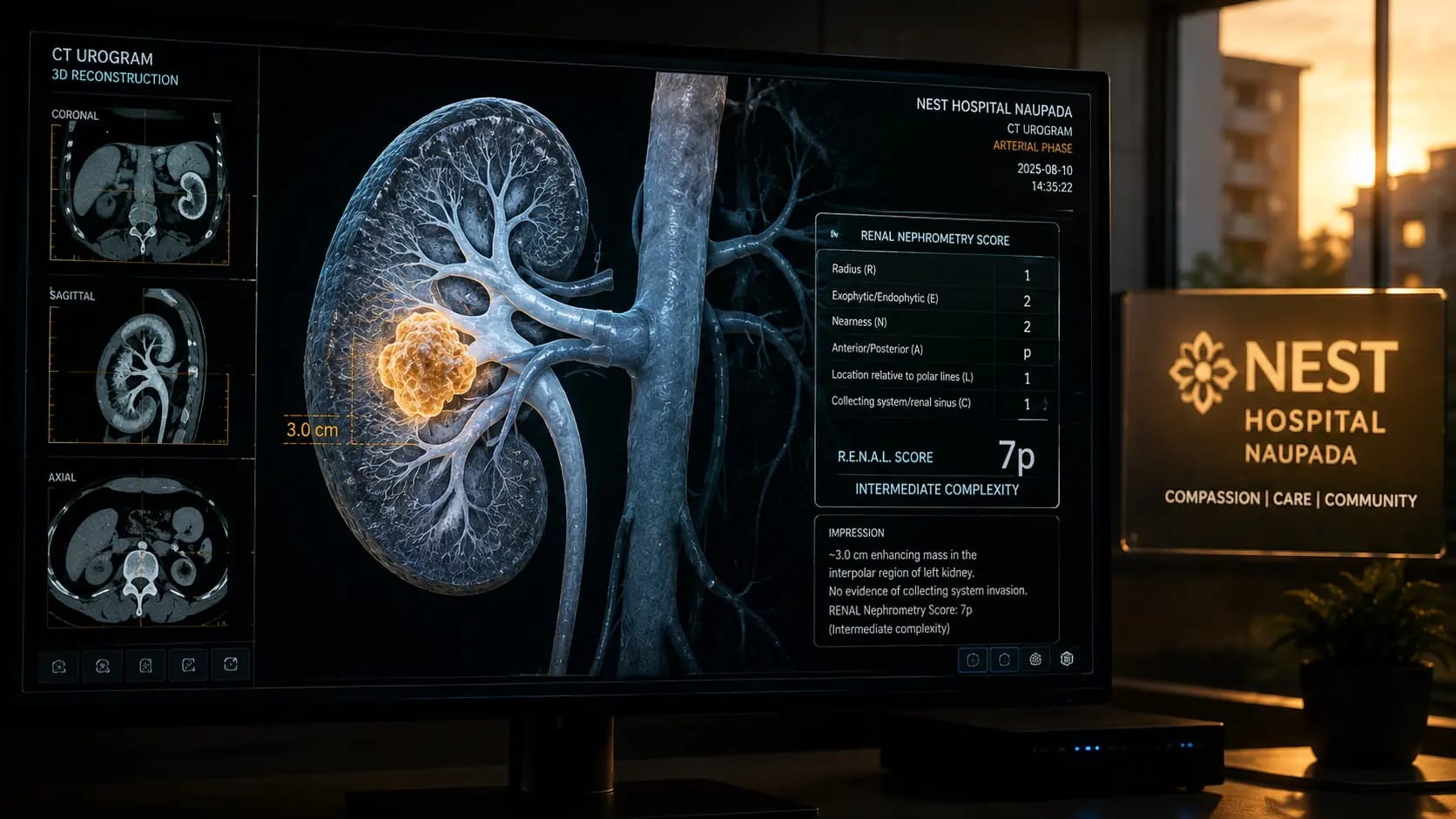
CT chest-abdomen-pelvis with contrast is the primary staging investigation. Laparoscopic partial nephrectomy preserves kidney function for tumours under 7cm; radical nephrectomy removes the entire kidney for larger tumours. Advanced RCC is managed with targeted therapy (sunitinib, pazopanib) or immunotherapy (pembrolizumab, nivolumab) via specialist MDT. Dr. Godbole is an experienced laparoscopic surgeon with published research in this field.
Why Timely Specialist Assessment Matters in Thane West
Kidney cancer in India is increasingly detected at earlier stages as CT scanning becomes more widespread.Read moreShow less
And early-stage detection dramatically improves outcomes. A tumour confined to the kidney has a 5-year survival rate exceeding 90% with appropriate surgical treatment; a tumour that has spread to lymph nodes or distant sites requires systemic therapy and has a significantly reduced prognosis. The difference between these outcomes often hinges on how quickly a patient receives specialist assessment after an imaging finding. HRG Urology at Nest Hospital provides rapid specialist interpretation of imaging and surgery scheduling — reducing the gap between diagnosis and treatment.
Laparoscopic Partial Nephrectomy — Kidney-Preserving Surgery in Thane
The goal of modern kidney cancer surgery is to remove the tumour while preserving as much functioning kidney tissue as possible.Read moreShow less
For tumours under 7cm, laparoscopic or robotic-assisted partial nephrectomy — removing only the tumour and a margin of surrounding tissue — achieves oncological equivalence to radical nephrectomy (removing the whole kidney) while preserving kidney function. This matters particularly for patients who have diabetes, hypertension, or who are at risk of chronic kidney disease — a substantial proportion of the Thane West community. Dr. Godbole's laparoscopic surgical experience makes nephron-sparing surgery available to Naupada and Thane West patients.
Travel and Parking Guide – Nest Hospital, Naupada
Behind State Bank of India, Naupada, Thane West 400602.Read moreShow less
Auto from Thane station: 10 minutes. From Vartak Nagar: 10–12 minutes. Parking near SBI.
Emergency Assessment for Blood in Urine
Any episode of visible blood in the urine (haematuria).Read moreShow less
Particularly minimally invasive haematuria — requires urgent specialist assessment to exclude kidney cancer and bladder cancer. Call HRG Urology at Nest Hospital on +91 88280 71522 for a priority appointment.
Why Nest
Laparoscopic partial nephrectomy.Read moreShow less
Kidney-sparing surgery — is available through Dr. Godbole's Thane practice, giving Thane West patients access to the same nephron-preserving surgical approach offered at major London cancer centres.
Nearby areas
Thane WestNaupadaVartak NagarWagle EstateKopri
HRG Urology at Nest Hospital serves kidney cancer patients from Thane West, Naupada, Vartak Nagar, Wagle Estate, Kopri, Louis Wadi, and the broader Thane district.Read moreShow less
Patients from Bhiwandi and Mira Road also attend as the closest Cancer Lead urology service in this part of Maharashtra.
Questions
I have been told I have a kidney mass on ultrasound in Thane West — what should I do next?
A kidney mass on ultrasound requires CT chest-abdomen-pelvis with IV contrast for proper characterisation — ultrasound alone cannot reliably distinguish benign cysts from kidney cancer. Call HRG Urology at Nest Hospital on +91 88280 71522 immediately. Dr. Godbole's team will arrange priority CT imaging and review the result with you within days, not weeks. Do not wait for a routine appointment when a kidney mass has been identified.
What is the difference between partial nephrectomy and radical nephrectomy for kidney cancer?
Partial nephrectomy removes only the tumour and a small margin of surrounding tissue, preserving the remaining kidney. Radical nephrectomy removes the entire kidney. Both achieve equivalent cancer control for tumours under 7cm confined to the kidney. Partial nephrectomy is preferred because it preserves kidney function — important for long-term blood pressure control, cardiovascular health, and reducing the risk of dialysis. Dr. Godbole's laparoscopic experience makes partial nephrectomy available for appropriate kidney cancer cases in Thane West.
Can kidney cancer be treated without surgery at Nest Hospital, Naupada?
Active surveillance — monitoring rather than immediate treatment — is appropriate for very small tumours (under 2cm) in older patients where the risk of surgery exceeds the risk from the tumour. Ablative therapies (radiofrequency ablation or cryoablation) are options for small tumours in patients who are high surgical risk. For most kidney cancers of significant size, surgery remains the primary treatment. Targeted therapy and immunotherapy are used for advanced or metastatic disease that cannot be surgically removed. Dr. Godbole's assessment determines which approach is appropriate for your specific tumour and health status.
How is laparoscopic kidney cancer surgery different from open surgery?
Laparoscopic surgery uses 3–5 small incisions (5–10mm each) through which a camera and instruments are inserted, rather than a large open incision. Benefits: significantly reduced blood loss, shorter hospital stay (2–3 days vs 5–7 days for open surgery), less post-operative pain, faster return to normal activity, and superior cosmetic result. Cancer control outcomes are equivalent to open surgery for appropriately selected cases. Dr. Godbole has published research on laparoscopic nephrectomy and routinely performs this as the preferred surgical approach.
My kidney cancer has been found at an early stage on a routine scan — does this improve my outlook?
Yes, significantly. Stage 1 kidney cancer (tumour confined to the kidney, under 7cm) has a 5-year survival rate exceeding 90% with appropriate surgical treatment. Stage 2 (tumour under 10cm confined to the kidney) has similarly outcomes. The fact that your cancer was found incidentally — before causing symptoms — typically means it is at an early, more treatable stage. This is why incidental imaging findings require prompt specialist assessment rather than a 'wait and see' approach.