Overview
Kalwa, Mumbra, Diva, and Airoli are communities where kidney cancer is diagnosed later than in more centrally located Thane areas.Read moreShow less
Partly because incidental imaging screening is less prevalent, and partly because haematuria (blood in the urine) is more frequently attributed to other causes without prompt specialist investigation. A kidney cancer diagnosis received late is harder to treat and produces worse outcomes than one found early. Rajiv Gandhi Medical College's institutional infrastructure — CT imaging, on-site laboratory, and specialist urology — combined with Dr. Harshawardhan Godbole's Cancer Lead experience, provides Thane East communities with access to early specialist kidney cancer assessment and treatment for the first time. Accessible by local train from Mumbra and Diva, the campus serves as the most practical cancer specialist option for communities that have historically been geographically underserved.
What to know
Kidney Cancer Treatment at Rajiv Gandhi Medical College, Kalwa
Kidney cancer — most commonly renal cell carcinoma (RCC) — arises from kidney tubule lining cells.Read moreShow less
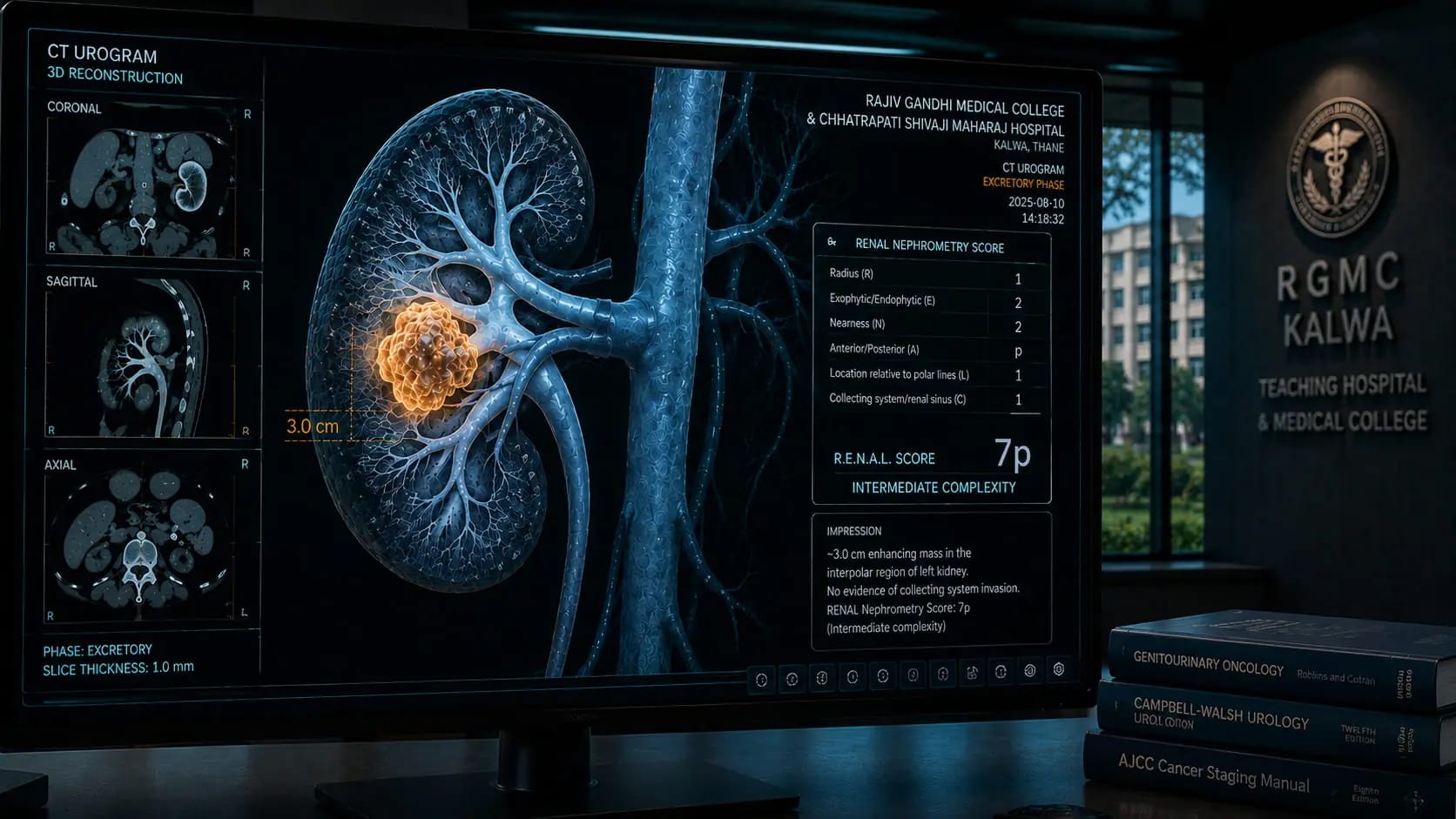
CT chest-abdomen-pelvis with contrast is the primary staging investigation. Laparoscopic partial nephrectomy preserves kidney function for tumours under 7cm; radical nephrectomy removes the entire kidney for larger tumours. Advanced RCC is managed with targeted therapy (sunitinib, pazopanib) or immunotherapy (pembrolizumab, nivolumab) via specialist MDT. Dr. Godbole is an experienced laparoscopic surgeon with published research in this field.
Later-Stage Presentation in Thane East — The Diagnostic Challenge
Kidney cancer in Kalwa, Mumbra, and Diva communities presents at more advanced stages than in areas with higher preventive screening uptake.Read moreShow less
Patients who develop haematuria often attribute it to UTI, prostate disease, or dietary factors and delay specialist assessment. By the time a kidney tumour causes visible symptoms — sustained haematuria, flank pain, abdominal mass, or weight loss — the tumour is often larger and in some cases has extended beyond the kidney. At Rajiv Gandhi Medical College, HRG Urology's team treats any episode of haematuria as a potential kidney cancer presentation until proven otherwise — arranging CT imaging urgently rather than assuming a benign cause.
Advanced Kidney Cancer — Systemic Therapy and MDT Management
For patients presenting with locally advanced or metastatic kidney cancer, surgical removal of the primary tumour (cytoreductive nephrectomy) may still benefit patients who can tolerate the procedure and who are candidates for systemic therapy.Read moreShow less
Dr. Godbole's Cancer Lead role provides the oncological framework for these complex treatment decisions — coordinating with medical oncologists for targeted therapy (sunitinib, pazopanib) or immunotherapy (pembrolizumab, nivolumab) through a proper MDT process. Thane East patients deserve the same MDT-level oncological decision-making as patients in more centrally located areas.
Travel and Parking Guide – Rajiv Gandhi Medical College, Kalwa
Rajiv Gandhi Medical College, Kalwa, Thane 400605.Read moreShow less
Local train: Kalwa station, 5 minutes by auto from campus gate. From Mumbra: 10 minutes by train. From Diva: 5 minutes. By road from Airoli: 20 minutes. Campus parking available.
Emergency Assessment for Blood in Urine
Any episode of minimally invasive blood in the urine in an adult over 40 requires urgent specialist assessment.Read moreShow less
This is a potential kidney or bladder cancer presentation. Call HRG Urology at Rajiv Gandhi Medical College on +91 88280 71522 for a priority appointment.
Why RGMC Kalwa
The medical college's CT imaging and laboratory infrastructure enables same-campus staging.Read moreShow less
CT, blood tests, and specialist review — within a single campus visit for patients from Thane East who travel specifically for this assessment.
Nearby areas
KalwaMumbraDivaAiroliThane East
Rajiv Gandhi Medical College serves kidney cancer patients from Kalwa, Mumbra, Diva, Airoli, Thane East, Vitawa, Kopri, and via the railway from Vashi and Ghansoli.Read moreShow less
The campus is a convenient specialist cancer urology option for Thane East without requiring travel to central Thane or Mumbai.
Questions
Can patients from Mumbra and Diva reach Rajiv Gandhi Medical College for urgent kidney cancer assessment?
Yes. Kalwa station is 5–7 minutes from Diva station and approximately 10 minutes from Mumbra station by local train. From Kalwa station, the medical college campus is 5 minutes by auto-rickshaw. HRG Urology at Rajiv Gandhi Medical College treats haematuria and kidney mass referrals as priority appointments — call +91 88280 71522 immediately if you have been told you have a kidney mass or have blood in your urine.
I have blood in my urine in Thane East — could this be kidney cancer and how urgently should I be seen?
Minimally invasive blood in the urine in an adult over 40 is a red flag symptom for kidney cancer (and bladder cancer) until proven otherwise. This requires urgent specialist assessment — not a GP antibiotic prescription. Call HRG Urology at Rajiv Gandhi Medical College on +91 88280 71522 immediately. The team will arrange CT imaging urgently and review the results with you. Most haematuria has a benign cause, but kidney and bladder cancer cannot be excluded without imaging and cystoscopy.
What is the typical recovery after laparoscopic kidney cancer surgery at the Kalwa campus?
Laparoscopic nephrectomy (partial or radical) typically requires 2–3 days of hospitalisation. Most patients return to light activity within 1–2 weeks and to desk work or light professional activity within 2–3 weeks. Physically demanding work and heavy lifting should be avoided for 4–6 weeks. The Rajiv Gandhi Medical College campus infrastructure supports this level of post-operative care within the same institutional setting as the surgery.
My father has kidney cancer that has spread to his lungs — is there treatment available at Rajiv Gandhi MC?
Yes. Metastatic kidney cancer (Stage 4) — where the cancer has spread to lungs, liver, or other sites — is managed with systemic therapy. Targeted therapy agents such as sunitinib or pazopanib, and immunotherapy agents such as pembrolizumab or nivolumab, are effective first-line treatments. Dr. Godbole's Cancer Lead role provides the framework for coordinating systemic therapy through oncology MDT for Thane East patients. Surgical removal of the primary kidney tumour (cytoreductive nephrectomy) may still be recommended in selected Stage 4 cases.
Is kidney cancer hereditary, and should other family members be tested?
Most kidney cancers are sporadic — not inherited. However, a small proportion (5–8%) are associated with hereditary syndromes including Von Hippel-Lindau (VHL) disease, hereditary papillary renal cell carcinoma (HPRC), and BAP1 mutation-associated cancer. Features suggesting hereditary kidney cancer include: young age at diagnosis (under 40), bilateral tumours, multiple tumours, and a family history of kidney cancer. If you have these features, genetic counselling and testing are recommended, and first-degree relatives may benefit from screening. Dr. Godbole's assessment at Rajiv Gandhi Medical College includes evaluation for hereditary risk where indicated.