Overview
Recurrent urinary tract infections are one of the most frequently mismanaged urological conditions in Thane West.Read moreShow less
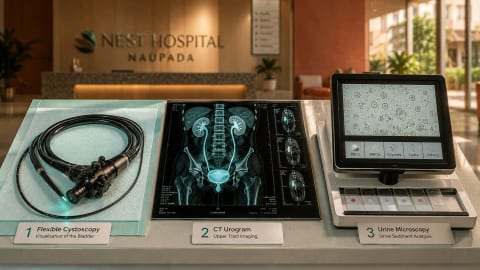
Patients cycle through repeated GP antibiotic prescriptions without ever having a urine culture, ultrasound, or cystoscopy to identify why the infections keep recurring. At Nest Hospital in Naupada, HRG Urology provides the specialist UTI assessment that breaks this cycle. For patients from Vartak Nagar, Wagle Estate, Kopri, and across Thane West who have been treated for recurrent UTIs without resolution, the clinic behind the State Bank of India in Naupada offers proper investigation — urine culture with sensitivity testing, renal ultrasound, and where indicated, flexible cystoscopy — at a consultation fee of ₹1,000. Dr. Harshawardhan Godbole FRCS and his team treat the cause, not just the episode.
What to know
UTI Treatment at Nest Hospital, Naupada
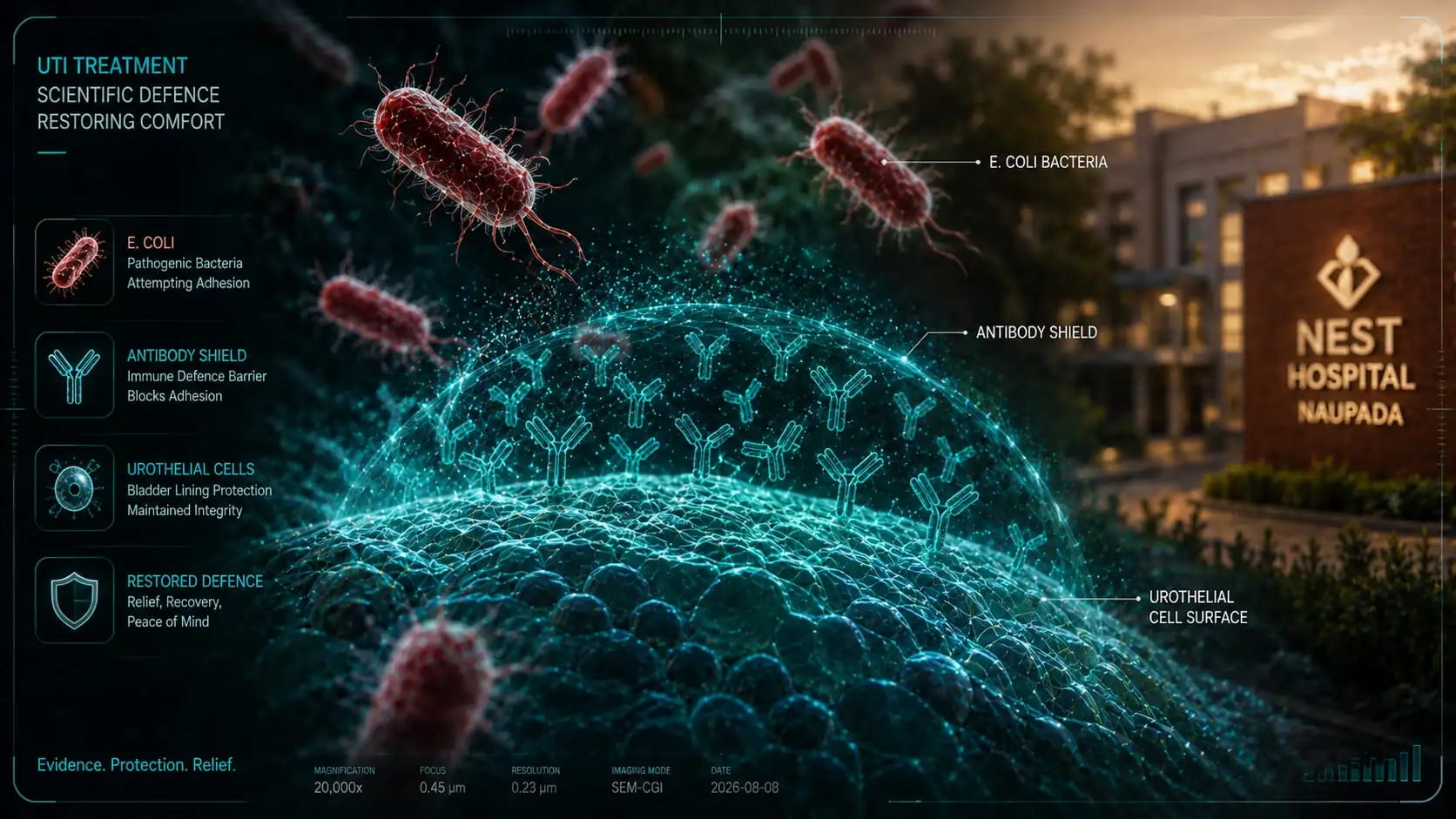
Urinary tract infections (UTIs) are caused most commonly by E.Read moreShow less
coli entering the urethra. Recurrent UTIs — three or more per year — require urine culture and sensitivity testing, ultrasound, and cystoscopy to identify structural causes. Culture-guided antibiotics prevent resistance. UTIs in men always require urological investigation. Complicated UTIs involving kidneys present with fever, flank pain, and require prompt specialist management.
Why Recurrent UTI Patients in Thane West Choose Nest Hospital
The pattern is consistent: a patient with their third, fourth, or fifth UTI in a year presents to a GP, receives a 5-day antibiotic course based on symptoms alone, and the infection appears to clear — only to return weeks later.Read moreShow less
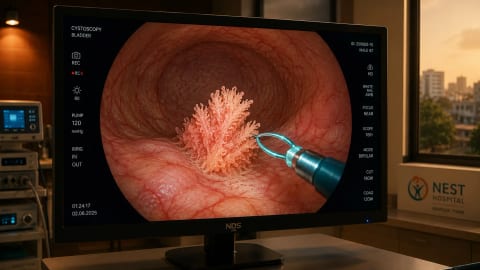
At Nest Hospital, HRG Urology's approach is structurally different. Every recurrent UTI is investigated with urine culture and sensitivity testing before antibiotics are prescribed, so that the correct antibiotic for the specific causative organism is always used. Furthermore, investigations to identify the structural or functional reason for recurrence — ultrasound for stones or anatomical abnormalities, post-void residual for incomplete emptying, cystoscopy for bladder pathology — are arranged systematically.
Common UTI Presentations at Nest Hospital, Naupada
Naupada and Thane West's UTI patient population is predominantly female.Read moreShow less
Consistent with the general epidemiology — with a significant subgroup of postmenopausal women in whom vaginal atrophy creates the microbiological environment for recurrent infection. Additionally, men presenting with their first UTI at Nest Hospital receive a prostate assessment, as male UTI almost always has an underlying urological cause that requires identification.
Travel and Parking Guide – Nest Hospital, Naupada
Behind State Bank of India, Naupada, Thane West 400602.Read moreShow less
Auto-rickshaw from Thane station: 10 minutes. From Vartak Nagar: 10–12 minutes. From Wagle Estate: 10–15 minutes. Parking available in the Naupada area near the hospital.
Why Nest
For women with postmenopausal recurrent UTI, Dr. Godbole's team at Nest Hospital addresses the hormonal component.Read moreShow less
Topical oestrogen — alongside antibiotic management, which significantly reduces recurrence rates in this specific patient group.
Nearby areas
Thane WestNaupadaVartak NagarWagle EstateKopri
HRG Urology at Nest Hospital serves UTI patients from Thane West, Naupada, Vartak Nagar, Wagle Estate, Kopri, Louis Wadi, and the broader Thane district.Read moreShow less
Patients from Bhiwandi and Mira Road who lack specialist urology access locally also attend this Naupada clinic.
Questions
I've had four UTIs this year and keep getting antibiotics from my GP in Thane West — what else can be done?
Four UTIs in a year qualifies as recurrent UTI and requires specialist investigation. At HRG Urology Nest Hospital, this means urine culture with sensitivity testing, renal ultrasound to check for stones or anatomical abnormalities, post-void residual bladder scan to exclude incomplete emptying, and flexible cystoscopy where bladder pathology is suspected. The goal is to identify the structural or functional reason for recurrence — not just to treat the next episode. Call +91 88280 71522 to book.
Can women in Vartak Nagar and Wagle Estate access UTI specialist care at Nest Hospital without a referral?
Yes. HRG Urology at Nest Hospital is accessible without a GP referral — you can call +91 88280 71522 directly to book a consultation. There is no referral requirement for private specialist care. Women from Vartak Nagar, Wagle Estate, Kopri, and the surrounding Thane West area can attend the Naupada clinic, which is 10–15 minutes by auto-rickshaw from all of these areas.
What is antibiotic resistance and why does it matter for recurrent UTI in Thane?
Antibiotic resistance occurs when bacteria evolve to survive the drugs designed to kill them — a growing problem in India where over-the-counter antibiotic availability has accelerated resistance development. In practical terms, it means the standard antibiotics used for UTI may no longer work for your specific infection. Urine culture with sensitivity testing identifies which antibiotics your specific bacteria are sensitive to, ensuring the prescribed drug will actually work rather than assuming standard empirical treatment is appropriate.
My UTI symptoms include blood in the urine — should I be worried?
Blood in the urine (haematuria) with UTI is common — the infection causes bladder inflammation that leads to bleeding from the bladder wall. However, haematuria can also indicate kidney stones, bladder cancer, or kidney disease independently of UTI. Haematuria that does not resolve completely after antibiotic treatment, or that recurs in the absence of infection, requires urgent cystoscopy and CT urography to exclude bladder cancer. At Nest Hospital, any UTI patient presenting with haematuria receives a clear plan for post-treatment haematuria follow-up.
Is HRG Urology at Nest Hospital able to see male patients with UTI, or is it primarily for women?
Yes — HRG Urology at Nest Hospital sees both male and female UTI patients. Male UTI is less common than female UTI, which is precisely why it should always be investigated: in men, a UTI almost always indicates an underlying urological condition such as BPH causing incomplete bladder emptying, a kidney stone, or a prostate issue. A male UTI treated with antibiotics alone without investigation risks missing a clinically significant underlying diagnosis.