Overview
For men in Kalwa, Mumbra, Diva, and Airoli, prostate cancer has historically been diagnosed late.Read moreShow less
Often after symptoms develop that indicate locally advanced or metastatic disease, because PSA testing and specialist urology assessment have not been accessible nearby. Rajiv Gandhi Medical College in Kalwa brings Cancer Lead specialist prostate cancer assessment to Thane East — accessible by local train from Mumbra in 10 minutes and from Diva in 5. The institutional infrastructure of the medical college campus supports PSA testing, on-site DRE, mpMRI coordination, and biopsy — a complete prostate cancer diagnostic pathway that has not previously been available to Thane East communities without travelling to Mumbai or central Thane. Dr. Harshawardhan Godbole FRCS, Cancer Lead at North Middlesex University Hospital NHS Trust, leads this service.
What to know
Prostate Cancer Treatment at Rajiv Gandhi Medical College, Kalwa
Prostate cancer is the most common cancer in men in the UK and among the top three in India.Read moreShow less
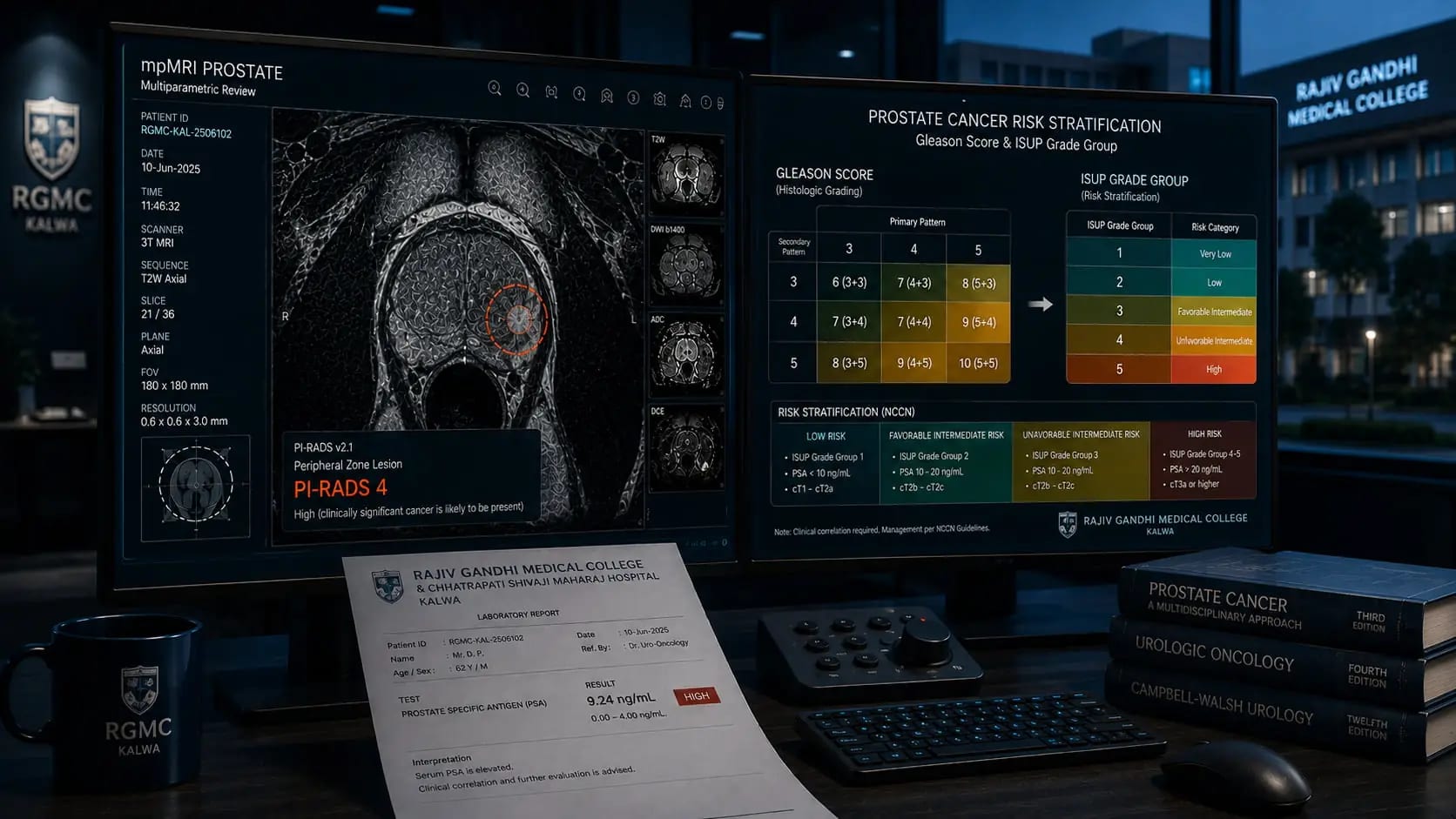
PSA blood test, digital rectal examination (DRE), multiparametric MRI (mpMRI), and transperineal biopsy confirm diagnosis and Gleason/ISUP grade. Active surveillance is appropriate for low-risk disease. Radical prostatectomy (laparoscopic) and radical radiotherapy with hormone therapy treat high-risk localised disease. Hormone therapy (ADT) with chemotherapy or novel hormonal agents manages advanced and metastatic disease through specialist MDT. Dr. Godbole is Cancer Lead and MDT Lead at North Middlesex University Hospital NHS Trust.
Late Presentation in Thane East — The Prostate Cancer Challenge
In Kalwa, Mumbra, and Diva's communities.Read moreShow less
Where preventive health screening is less prevalent and specialist urology access has been limited — prostate cancer presents at more advanced stages than in urban centres. Many men first seek medical attention when urinary obstruction, bone pain, or significant weight loss develops — symptoms indicating locally advanced or metastatic disease. At Rajiv Gandhi Medical College, HRG Urology's approach to any man over 50 with new urinary symptoms includes PSA testing as a standard component — because BPH and prostate cancer produce overlapping symptoms, and a missed prostate cancer diagnosis is clinically significant.
Hormone Therapy Coordination for Advanced Prostate Cancer in Thane East
For men with locally advanced or metastatic prostate cancer requiring long-term hormone therapy (ADT), the management involves injections, monitoring for cardiovascular and metabolic effects, and coordination with bone health management.Read moreShow less
At Rajiv Gandhi Medical College, the institutional infrastructure supports this long-term management — laboratory testing, bone density monitoring, and coordination with cardiology — within the same campus. For patients from Mumbra and Diva who travel specifically to Kalwa for care, having all monitoring components available at the same campus significantly reduces the logistics of long-term cancer management.
Travel and Parking Guide – Rajiv Gandhi Medical College, Kalwa
Rajiv Gandhi Medical College, Kalwa, Thane 400605.Read moreShow less
Local train: Kalwa station, 5 minutes by auto. From Mumbra: 10 minutes by train. From Diva: 5 minutes. By road from Airoli: 20 minutes. Campus parking available.
Why RGMC Kalwa
Mumbra, Diva, and Airoli men choose Rajiv Gandhi Medical College for prostate cancer assessment because Kalwa station is 5–10 minutes by local train.Read moreShow less
Bringing Cancer Lead specialist prostate oncology to communities where it has been absent.
The campus infrastructure at Rajiv Gandhi Medical College supports the complete prostate cancer diagnostic pathway.Read moreShow less
PSA, DRE, mpMRI coordination, biopsy, and staging — within a single institutional setting.
Nearby areas
KalwaMumbraDivaAiroliThane East
Rajiv Gandhi Medical College serves prostate cancer patients from Kalwa, Mumbra, Diva, Airoli, Thane East, Vitawa, Kopri, and via the railway from Vashi and Ghansoli.Read moreShow less
The campus is a convenient Cancer Lead specialist urology option for Thane East.
Questions
Can men from Diva and Mumbra access prostate cancer specialist assessment at Rajiv Gandhi Medical College by train?
Yes. Kalwa station is 5 minutes from Diva station and approximately 10 minutes from Mumbra station by local train. From Kalwa station, the medical college campus is 5 minutes by auto-rickshaw. HRG Urology's prostate cancer assessment at Rajiv Gandhi Medical College is therefore accessible from Thane East communities without requiring private transport or a long journey.
My father has bone pain and an elevated PSA — could this be metastatic prostate cancer?
Bone pain combined with an elevated PSA is a pattern that must be urgently assessed for metastatic prostate cancer. This combination — particularly with back or hip pain — requires bone scan or PSMA PET-CT to assess for bone metastases, as well as full staging CT. Call HRG Urology at Rajiv Gandhi Medical College on +91 88280 71522 immediately for a priority appointment. Do not delay this assessment.
What is PSMA PET-CT and is it available for prostate cancer staging in Thane?
PSMA (prostate-specific membrane antigen) PET-CT is an advanced imaging technique that detects prostate cancer spread to lymph nodes and distant sites far more sensitively than conventional CT or bone scan. It is increasingly the preferred staging investigation for intermediate and high-risk prostate cancer. PSMA PET-CT is available at specialist imaging centres in Mumbai and Pune; Dr. Godbole's team at Rajiv Gandhi Medical College coordinates referral for this investigation where clinically indicated for Thane East patients.
Is prostate cancer more common in Indian men with a family history of the disease?
Yes. Men with a first-degree relative (father or brother) who had prostate cancer have approximately twice the general population risk. Men with two or more first-degree relatives affected have a 5–11 fold increased risk. The genetic basis includes BRCA2 mutations — which significantly increase prostate cancer risk as well as aggressive disease behaviour. Men with a family history of prostate cancer, particularly if a relative was diagnosed under 65, should begin PSA screening from age 45 rather than 50.
What is the PSA bounce after radiotherapy and should I be worried?
A PSA bounce — a temporary rise in PSA of less than 2ng/ml during the first 18 months after radiotherapy — occurs in approximately 30% of patients and does not indicate treatment failure. It is caused by radiation-induced prostate inflammation and resolves spontaneously. A PSA bounce must be distinguished from a true biochemical recurrence — a PSA rise of 2ng/ml or more above the post-treatment nadir — which does indicate disease recurrence. Dr. Godbole's post-treatment monitoring at Rajiv Gandhi Medical College distinguishes between these patterns at each follow-up visit.